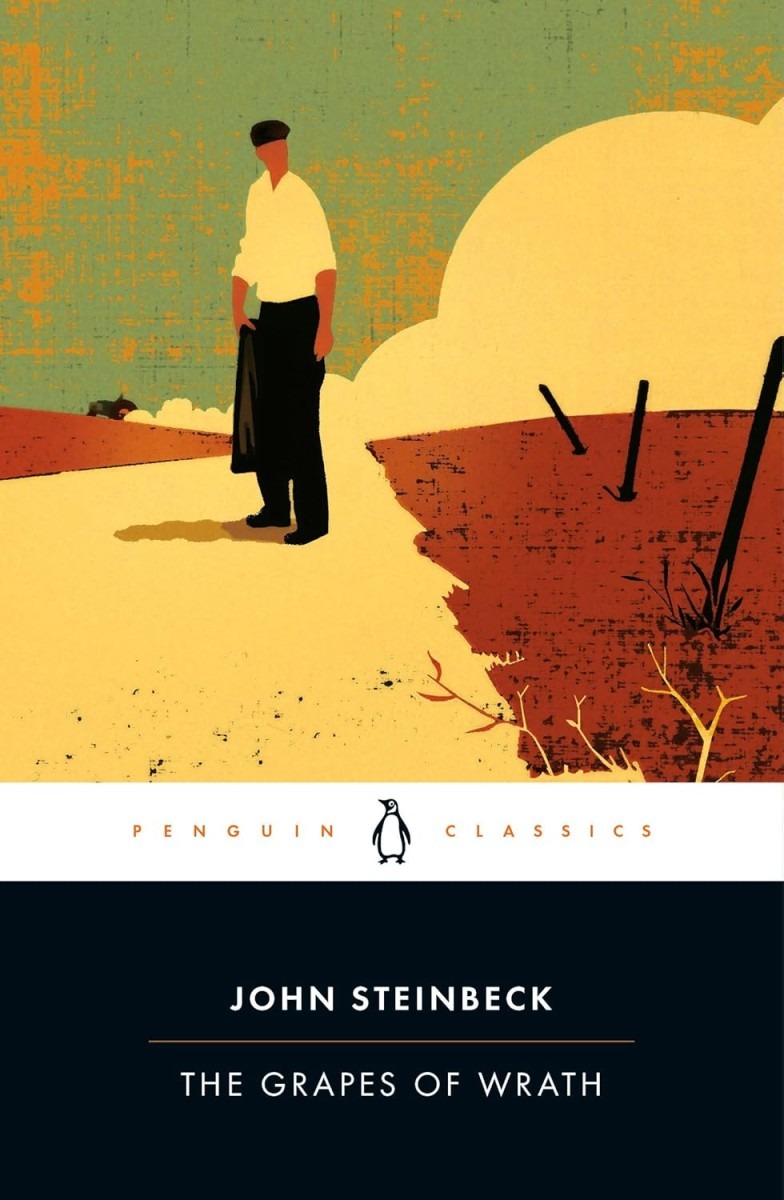
Though this book I learned much about a period of US history I’m not very familiar with. In school we have our history lessons but they’re usually just facts and figures combined with some photographs. This isn’t enough to give us a true feeling of what people went through.
The closest we can come to understanding is through wonderful novels like these. We see the hardships through the characters eyes and it is as though we’re on the journey with them. In fact, I even felt a little anxious as though I’d be stranded right along with them with no money, a car that is always on the verge of breaking down and in a land where nobody wants you.
Although this is a fictional family, those times and hardships they went through were very real for millions of families. I found it difficult to read that the banks just kicked people off their land, land they’d tended for a generation or two over what was most likely very little debt. As I continue to learn more about the history of the USA, and given the blatant grift and rape of the USA from the Trump Administration we’re currently living through, one main question began to form in my mind.
Has the USA ever had leaders who made decisions for the good of the country, rather than how it would be profitable for them?
I know about the New Deal, that which Magats of today would deride as “socialism.” I’m sure there are thousands of examples, but for most of my life, it seems decisions are primarily made to enrich the wealthiest members of society at the expense of the Middle Class and below. At 48 years old my conclusion remains that America is primarily a business that doesn’t care much for its own citizens. American sure didn’t care about the millions of poverty stricken migrants fleeing the dust bowl in his novel. In fact, I learned that people in other states were outright hostile! Again, the more I learn about America the more it seems that doing things like standing for the national anthem is such a farce. It is nice and we all feel a bit of patriotism, all the while jobs are shipped overseas (now AI), taxes are cut for the rich and another war is started so companies can make even more profit.
I guess you could say this novel made me even more disillusioned than before. Let’s get to the quotes.
Women and children knew deep in themselves that no misfortune was too great to bear if their men were whole.
There ain’t no sin and there ain’t no virtue. There’s just stuff people do. It’s all part of the same thing. And some of the things folks do is nice, and some ain’t nice, but that’s as far as any man got a right to say.’
Some of them hated the mathematics that drove them, and some were afraid, and some worshiped the mathematics because it provided a refuge from thought and from feeling. If a bank or a finance company owned the land, the owner man said, The Bank—or the Company—needs—wants—insists—must have—as though the Bank or the Company were a monster, with thought and feeling, which had ensnared them.
In current times those companies are ‘people.’ Not much has changed and the banks remain monsters. They did stumble in 2008 with the financial crisis, under the weight of their own debt but alas, they were “too big to fail.” Again, just another reason that the USA isn’t a country that takes care of its own citizens, but it will take care and even break laws for its wealthiest masters.
When the monster stops growing, it dies. It can’t stay one size.
Numbers must always go up, no matter how many wars have to be fought, or people in poverty must die. The American engine runs on profit and profit here is worth more than human life.
Grampa took up the land, and he had to kill the Indians and drive them away. And Pa was born here, and he killed weeds and snakes. Then a bad year came and he had to borrow a little money. An’ we was born here. There in the door— our children born here. And Pa had to borrow money. The bank owned the land then, but we stayed and we got a little bit of what we raised.
I had to reflect on ‘Grandpa killing the Indians.” Another very sad fact of American history. America is built on greed, slavery and broken treaties. The school history books gloss over all this with grand ideas like “Manifest Destiny.” See! We’re allowed to kill all the Indians because God wants us to have all this land. I’m so tired of stupid people always referencing God when doing something that God would inherently be against, such as killing his people or poisoning his own creation. Human beings are so primitive.
The bank is something else than men. It happens that every man in a bank hates what the bank does, and yet the bank does it. The bank is something more than men, I tell you. It’s the monster. Men made it, but they can’t control it.
Ever’ time Pa seen writin’, somebody took somepin away from ’im.’’
There is a phrase I cannot find that sarcastically states Western men are incapable of coming to an agreement without lawyers, contracts and signatures. This remains true today with pages of fine print we all agree to for pretty much every service, app, or purchase etc we make. I’m also quite sure, none of it is for our own benefit. Pa Joad had a right to be wary of writing.
Well, what happened to them? What happened to the folks in that car? Did they walk? Where are they? Where does the courage come from? Where does the terrible faith come from?
This references an abandoned car on the side of the road. What would a family do with no car, no money, no home? Not to mention they are in a different state which might as well be an enemy foreign country the way they are treated.
The one-eyed man said softly, “Think—somebody’d like—me?’’ “Why, sure,’’ said Tom. “Tell ’em ya dong’s growed sence you los’ your eye.’’
goddamn it, Al, don’ keep ya guard up when nobody ain’t sparrin’ with ya. You gonna be all right.’’
He wailed the song, “I’m Leaving Old Texas,’’ that eerie song that was sung before the Spaniards came, only the words were Indian then.
I’m fascinated that many of the old American folk songs could be adapted from original Native American songs. I asked AI if there was an identified Native American song here and got the following.
“There is no widely recognized Native American song by that exact name, but the passage reflects Steinbeck’s nod to the deep, pre-colonial roots of some American folk music.”
They’s a fella, newspaper fella near the coast, got a million acres—”1 Casy looked up quickly, “Million acres? What in the worl’ can he do with a million acres?’’ “I dunno. He jus’ got it. Runs a few cattle. Got guards ever’place to keep folks out. Rides aroun’ in a bullet-proof car. I seen pitchers of him. Fat, sof’ fella with little mean eyes an’ a mouth like a ass-hole. Scairt he’s gonna die. Got a million acres an’ scairt of dyin’.’’
William Randolph Hearst. We’ve been to his castle, now run by the State of California as a tourist destination. It was interesting to see him mentioned in the novel and it is even more interesting to see how his influence reverberates through American society today. Another example of how America is primarily an oligarchy and always has been .
The Mexicans were weak and fled. They could not resist, because they wanted nothing in the world as ferociously as the Americans wanted land. Then, with time, the squatters were no longer squatters, but owners; and their children grew up and had children on the land. And the hunger was gone from them, the feral hunger, the gnawing, tearing hunger for land, for water and earth and the good sky over it, for the green thrusting grass, for the swelling roots.
Interesting to see how the ‘white man’ just took land and eventually became ‘owners.’ The Mexicans had contracts, signatures and laws, as did the Spanish before them. But, when you’re not in the same tribe, all those contracts, signatures and laws don’t mean anything do they? No laws or contracts are ever permanent are they. Just paper with words that the tribe in power made which can easily be thrown in the fire should a stronger tribe appear.
A man might work and feed himself; and when the work was done, he might find that he owed money to the company. And the owners not only did not work the farms any more, many of them had never seen the farms they owned.
What if they won’t scare? What if some time an army of them marches on the land as the Lombards did in Italy, as the Germans did on Gaul and the Turks did on Byzantium? They were land-hungry, ill-armed hordes too, and the legions could not stop them.
when property accumulates in too few hands it is taken away. And that companion fact: when a majority of the people are hungry and cold they will take by force what they need. And the little screaming fact that sounds through all history: repression works only to strengthen and knit the repressed.
And this was good, for wages went down and prices stayed up. The great owners were glad and they sent out more handbills to bring more people in. And wages went down and prices stayed up. And pretty soon now we’ll have serfs again.
Is this cyclical? It seems we are halfway there here in America already. We have houses the young cannot afford, record profits but declining wages in the most powerful companies in human history , a disappearing middle class and a growing distain for the poor. With AI I can see a future where control of the masses is even more pronounced as the wealth continues to funnel upward (so much for “trickle down.) As you can see, I’m not optimistic.
In the souls of the people the grapes of wrath are filling and growing heavy, growing heavy for the vintage.
Note:
The Ghost of Tom Joad – Bruce Springsteen
The Ghost of Tom Joad – Rage Against the Machine
