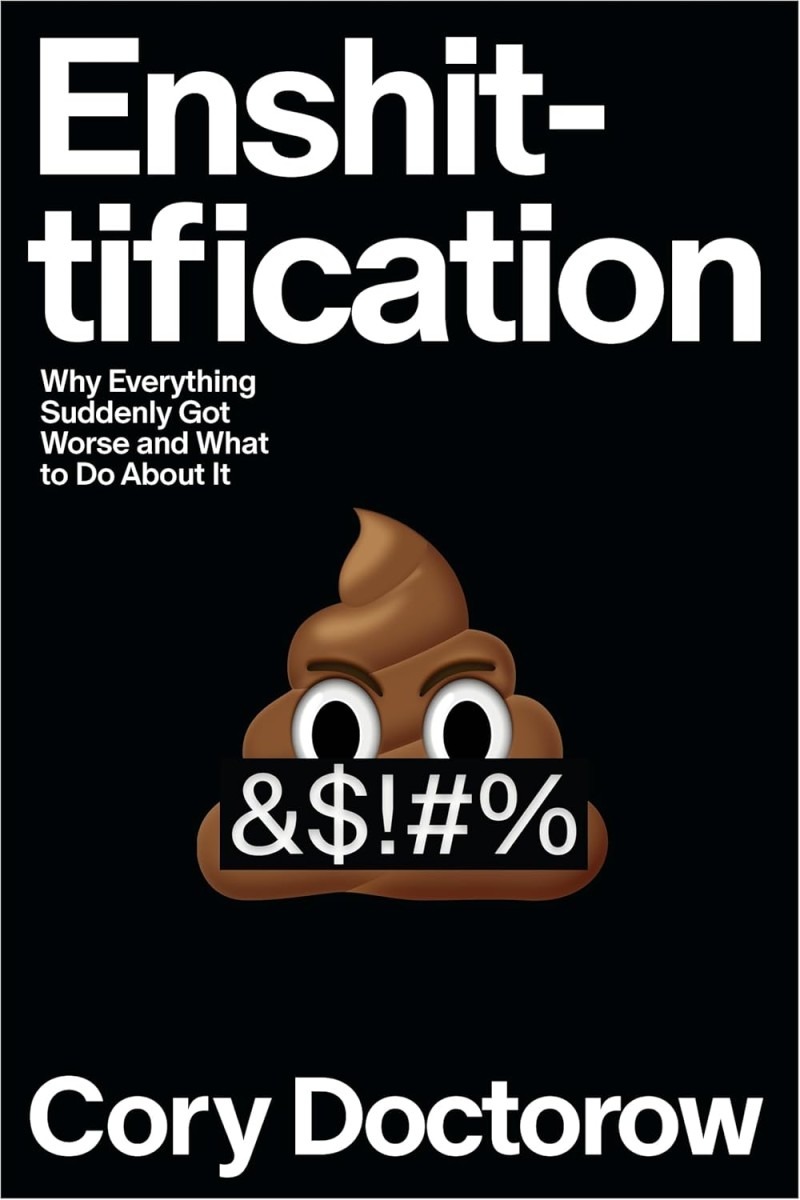
For most of my life I’ve been an enthusiastic technology adopter. I’m older so I remember the utopia the original internet was supposed to bring about. We were to be more connected, better informed, and this was to lead to a better society and perhaps even world peace! Obviously this was an illusion and instead of bringing out a better life technology, especially in the past five years, has become something more likely to want to harm us than provide a benefit.
From social media and phone addictions to treating us all as products, eyeballs for advertisements to suckers for yet another subscription, the internet and technology has become something I’m trying to lessen and in some aspects, actively avoid in my life.
Much of technology is designed to suck up as much of our time as possible. We cannot get away from technology completely and so I must make a conscious effort as to how I’ll use it and how I’ll limit its ever increasing tentacles in my, and my family’s life. It isn’t easy. Everyday, there are more advertisements, more seductive (and sometimes demands) for subscriptions and all the while a huge part of the internet seems to be getting worse?
I was very glad to read this book as it confirmed and beautifully explained what I saw before my very eyes. We are in the “enshitocene” period of the internet!
There’s a name for this strategy, coined by the librarian-theorist Fobazi Ettarh: vocational awe. Ettarh uses this term to describe the weaponization of workers’ sense of duty, especially to the public those workers serve.
This seems to be a lesson learned over and over again: companies are not your friends, you are not family, and in the end, you’re not working for the greater good. You’re working to make a profit for the shareholders and owners – that’s it! At the end of the day, no matter how many mission statements are created, rainbows drawn, ‘we’re family’ utterances mentioned businesses exist to make money above all else. In America that is taken to such extremes that as this books mention, will eventually turn products and services into complete piles of shit.
Hell, fill your printer with ditchwater if you want! Or vintage Veuve Clicquot (which costs a fraction of what HP charges for ink).
I learned a decade ago that printer companies make their money on ink, not the printers themselves. As this book rightly points out, the amount they charge for ink is obscene! So I did my research and switched to a Brother laser printer and it has been both wonderful and cheaper than the evil HP company.
Enshittification is when you combine the banality of evil with an internet-connected device and a federal law that criminalizes doing anything with that device that the manufacturer dislikes.
This is why every company is so sweatily insistent that you use its app rather than its website. An app is a website wrapped in enough IP to make it a felony to install an ad blocker or any other modification that makes the product work better for you at the expense of the company’s shareholders.
Apps are convenient but we must understood that in many cases the price for that convenience is too high when their mobile site may work just as well. Many apps are invasive, data collecting piece of spyware that are unneeded. But the company will remind us over and over again to download and install this piece of spyware as it benefits them more than us.
Tech workers’ dreams have shrunk to pinpricks. Now the aspiration is “Get a $300,000 engineering degree, get an $80,000-a-year job at a tech company, and pay off as much student-loan debt as you can before they fire your ass in the same year you hit every one of your performance metrics while they’re making record profits.”
From 2010 – 2020 I was somewhat disappointed I didn’t choose a job in technology. Seeing what they’ve become, given their insatiable desire for profit over all else, I have, in the past three years especially, become very glad I did not go for a job in tech companies. There is so much volatility: companies come, go, merge, layoff, hire, layoff again and generally run their workers ragged. Yes, the salary would have been very nice but at what cost?
Donald Trump’s election represents the ultimate triumph of enshittification in the political realm. The policies that enable enshittification—lax antitrust, regulatory capture, weak labor laws, and state intervention on behalf of incumbents—are all on Trump’s agenda. After a four-year period of antitrust and labor vigor not seen for two generations, the United States has taken a huge step back—and its major trading partners like the United Kingdom and the European Union are also backsliding dramatically.
This is the enshittifier’s credo: “We’re just doing the thing that makes life worse for you so we can make life better for us.
Well put. The trick is to disentangle ourselves from the technology we’ve come to rely on or that have become habit forming. Not easy to do, when they are specifically designed to keep you hooked.
There’s some logic here: if a search engine knows what region you’re in, it might do better in answering a question like When does Daylight Savings start? But Google is palming a card here, conflating the marginal improvements it gets from using context to customize search results and data-mining responses to those customizations with the massive, pernicious, multifaceted program of commercial surveillance it carries out for ad targeting.
I like his metaphor, “palming a card.” I remember reading a quote from a Google employee perhaps 10 or 15 years ago that explained they needed personal information from us to make search results and their product in general more relevant to us. It made sense then and it makes sense now. How can I ask it about movie showtimes if it doesn’t know where I am? But yes, they are ‘palming a card’ and doing ‘the evil thing’ when they used to be the company whose motto was “don’t be evil.” Well, during the enshittification process they quietly removed that motto and most certainly do whatever evil thing is necessary to increase their stock price.
Well, this is business and to be more specific, this is American business – it is profit over all else. It would be much less frustrating if companies just said that directly instead of trying to using some sort of PR rhetoric, some half-truth, stating that their existence is a net benefit for humanity when often times, their existence is actively and extremely harmful to humans and the planet.
Of course, if you ask the orthodox economists who oversaw this transformation about the monopolization of the economy, they’ll insist that there’s no way to dispositively connect the pro-monopoly policies they supported with the monopolies that resulted.
Ha ha, this is so true with so many of the talking heads today. It reminds me of a funny definition for an economist I once heard.
“An economist is an expert who will know tomorrow why the things he predicted yesterday didn’t happen today.”
Cyberspace is everting. The twiddling that was once the exclusive domain of virtual services you access through a screen is now commonplace in physical systems of the world.
Yes, technology has become invasive. The internet used to be a destination, a place I would go to, sit down, listen to some weird computer noises, get connected and then spend an hour or two ‘surfing.’ Now, the internet reaches into many aspects of my life from which I cannot escape and it will only get worse. Let’s name a few shall we?
- Continual notifications from my work computer – annoying beeps that demand my attention and eyeballs come back to it.
- My phone where I have 90% of notifications turned off but still allow for some. This I feel as though I have some control over unlike work.
- We’re all tracked both in the virtual and physical worlds all the time. Unless you drive your car without a license plate, leave your phone at home and wear a face shield for the ubiquitous surveillance cameras you’re tracked to a degree most are unaware of.
- My own mind: much technology, especially social media, is designed to be addictive. I find myself reaching for my phone out of habit to check Reddit or the news. I need to actively train myself to get away from this habit.
Well, no summary for this post other than that I’d like to say how thoroughly I enjoyed this book. I also caught the author on the Ezra Klein podcast for the episode “We Didn’t Ask for This Internet” and I enjoyed one of his rants so much I’ll post it here.
And one day, Mark Zuckerberg arises from his sarcophagus and says: Hearken unto me, brothers and sisters, for I’ve had a vision. I know I told you that the future would consist of arguing with your most racist uncle using this primitive text interface that I invented so I could nonconsensually rate the [expletive] of Harvard undergraduates, but actually, I’m going to transform you and everyone you love into a legless, sexless, low-polygon, heavily surveilled cartoon character so that I can imprison you in a virtual world I stole from a 25-year-old comedic dystopian cyberpunk novel that I call the Metaverse. – Cory Doctorow
